• HOME
  • About
  • Published Works
  • Current Projects
  • Blog
  • Connect
Menu

www.kevinlandpatrick.com

Street Address
City, State, Zip
Phone Number

Your Custom Text Here

www.kevinlandpatrick.com

  • HOME
  • About
  • Published Works
  • Current Projects
  • Blog
  • Connect

JUST SAY NO

February 8, 2026 Kevin Patrick

I’ve written before on the water and electric consumption of datacenters and the wisdom of developing them in arid locales. Today, I want to discuss the difference between wholly wasteful and preventable water and electric use and “necessary” water use.

First, the why? Datacenters are inevitable in our digital economy. Efficient datacenters located in areas with abundant water supplies are necessary development to be endorsed. Datacenters developed without regard to the waterscape, make little sense. I’ll give you an example.

Amarillo receives 19-20 inches of precipitation per year on average, an arid geographic region characterized by sage brush, arid grasses, and cactus. Fermi America proposes to construct 18 million square feet of datacenters powered by four small nuclear reactors and one gas generation facility. One of the principals is Rick Perry, former Governor of Texas. The name given to this, Project Matador, is not the name on the Federal Nuclear Energy Commission application (the NEC approves and regulates all  nuclear power plants). The applicant listed is The Donald J. Trump Advanced Energy & Intelligence Campus. Now that’s a name that should get a quick approval. Never mind that nuclear plants typically use 20-50 gallons of water to generate ONE kilowatt hour (1 kWh) and this project advertises it will generate 11 Gigawatts (11.0 million kWh) in the arid locale of the Texas panhandle. Do the math.

While no one questions the need for datacenters (after all, it took electrical energy and computing power to generate this article), datacenters are not just necessary to supply the nation’s computing and AI future. Those are what I would label “necessary uses” that drive datacenter development. The unnecessary and wasteful use that is also driving datacenter development is cryptocurrencies.

There are many cryptocurrencies out there but perhaps Bitcoin is the best known. Bitcoin alone required a reported 175 Terawatts/year of electric energy last year. That’s 175 billion kilowatts. While renewable energy generation requires virtually no water consumption, coal, nuclear, and gas generation requires serious quantities of water to generate the stream necessary to spin turbines to generate electricity.  Given that cryptocurrencies have no social, economic, cultural, or employment value, the need is wasteful. Cryptocurrencies are merely financial tools. They do not create jobs. Investing in the stock market means you are investing in companies that generate some service or product that benefits society or at least the employees that work for those companies. That can’t be said for cryptocurrencies. They’re a waste one can do without.

But they are a great investment tool you say. If you really believe that, you haven’t been looking at your investment lately. Just like recycling, we can all do our little part in the future. So, when it comes to deciding whether to add cryptocurrencies to your portfolio, I harken back to the wisdom of former First Lady Betty Ford, Just Say No.


WHY INFLATION IS RAMPANT IN THE ELECTRIC UTILITY SECTOR

February 1, 2026 Kevin Patrick

Electric rates have surged far higher than the Consumer Price Index. Across the country, rates have escalated in 2025 from 5% to as high as 14%. The reasons boil down to policies. Sure, natural gas prices have risen, as have the costs of replacement infrastructure, but the real driver in utility raises have been poor governance.

Across the country, rates for electricity are set by agencies and commissions that regulate “public utilities.” They go by a myriad of titles, depending on which state you are in. Arizona’s agency is the Arizona Corporation Commission, Colorado’s is called the Colorado Public Utilities Commission, then there’s the Virginia State Corporation Commission, and the Illinois Commerce Commission. In roughly a third of the states, seats on these boards are elected while the balance are appointments by either the Governor or Legislature of the state. Most have one thing in common; they are subject to lobbying.

Three factors primarily drive rates: 1) Increase in electrical demand; 2) aging infrastructure (grid); and 3) costs of electrical generation. Seems pretty straightforward, doesn’t it? That’s what some would like to have you believe.

Let’s take a closer look at these three drivers.

·       Increase in Electrical Demand: With the nation’s population nearly flatlining, what is driving the need for more electricity? Sure, migration to certain areas increases population and demand, but that’s not it. Demand is being driven by smart appliances and the digital world we live in. Chief among these is AI and datacenters. One mega datacenter can use the power that a city of 750,000 uses. And, don’t get me talking about freshwater water usage for cooling and electrical generation. Take for example Arizona, a State in water crisis is the ranked 5th in the country for the number of datacenters. The Arizona Corporation Commission is weighing a rate increase of 14% this year for Arizona Public Service (APS), its third rate increase in four years. Rather assign the new infrastructure costs to the entities and new users that demand new infrastructure (like datacenters), costs are typically spread out amongst all users. It’s about policies that assign costs to those triggering new costs, common sense approaches lobbyists resist.

·       Aging Infrastructure: The grid is old and in need of hardening and upgrades. It has been neglected for decades. The costs of new infrastructure (equipment, poles, wire) have all escalated because of inflation and tariffs. But again, the demand for replacements, upgrades and expansions are being driven at a far faster pace by the new demands.

·       Costs of Electrical Generation: With the exception of renewables (hydro, wind, and solar), generation of electricity involves heating water to steam that drives turbines. Coal, natural gas, nuclear, they all use the same steam generation process. In 2025, the administration has embarked on a war against renewables (the Department of Energy is clawing back $1.8 billion in loan money from the APS designed to fund renewable generation, transmission and battery storage).

Arizona, like a great many purple and red states are mandating natural gas generating stations, despite coal and natural as being more costly to operate (not to mention water consumption again). Arizona is not alone.

Policies are choices. The common legislative authorization preamble for these state rate setting entities is to regulate industries for the public good. That goal seems to be getting lost far too often.


ENVIRONMENTAL INSURRECTION A/K/A DON’T BE FOOLED BY THE WEATHER

January 25, 2026 Kevin Patrick

INSURRECTION. That’s a word being tossed around like never before. The word, insurrection, came (of course) from the French, insurgere meaning “to rise up.”

The United States has had a couple of “insurrections” in its history, from the Whiskey Rebellion of 1791-1794 (Kentucky distillers refusing to pay tax turned a bit ugly…whisky never calms things down), Nat Turner’s Slave Rebellion of 1831 in Virginia, the American Civil War, the Greenwood New York Insurrection of 1882 (an uprising over the refusal to pay railroad bonds for a railroad that was never built), to the January 6, 2021 Capitol riot. Each of these were found by our courts to have constituted not mere riots but an insurrection.

But I never heard of the latest insurrection that was proclaimed just yesterday: Environmental Insurrection.

Every crime must meet certain elements. For insurrection, they are spelled out 18 U.S.C. §2383:

Anyone who "incites, sets on foot, assists, or engages in any rebellion or insurrection against the authority of the United States or the laws thereof, or gives aid or comfort thereto," is guilty of the crime.

This is serious stuff, punishable by up to ten years in prison, penalties or both.

So, yesterday in a social media pronouncement, a certain someone announced that everyone who believes or asserts that climate change is a thing, is henceforth labeled an Environmental Insurrectionist. Never mind the irony of the utterance of that term…it labels every reputable scientist and the vast majority of Americans insurrectionists for believing in fact.

How did this come to be? The basis for the claim was that in advance of the major winter storm that now grips a majority of the states, that cold snap disproves climate change. Don’t laugh, a certain someone really said that. But, it always comes down to knowledge. Knowledge that weather is not climate. Climate is not weather. Climate change does not mean only warming. NOAA defines the difference as: “Weather refers to short-term changes in the atmosphere, climate describes what the weather is like over a long period of time in a specific area.”

Climate change can be viewed as a disruptor. As the atmosphere heats (and it has been on a steady, unabated trajectory for 50+ years), the atmosphere has greater energy (heat = energy). That results in stronger storms, greater droughts, and most importantly, new normals.

Take the western United States, as of today, the USGS and National Climate Center shows measured precipitation and snowpack across the west at between 30-45% of normal…and this has generally been the pattern for the last 25 years. That long term pattern is climate (not weather). And, the problem is not confined to one region. Colorado statewide ranges from 25-46% of average. Arizona is between 7-37% of normal. Even Oregon is suffering between 4-39% of normal. Those are sobering statistics for the end of January.

The statistics forecast another dangerous wildfire season, another tough economic season for farmers and ranchers who end up with half the water they need and twice the economic headaches they deserve.

What I’m trying to drive home here is that the agitators or “environmental insurrectionists” are not the country’s scientists, water planners, engineers, educators, farmers, and ranchers. The truth and facts are sometimes unwelcome. It’s another divisive term used to disparage fellow Americans. But hey, I think there’s a future economic play here for someone wanting to print bumper stickers and pins for those that want to identify as Environmental Insurrectionists. I know I’d buy one.


YOUR MOTHER TOLD YOU NOT TO LIE AND HIDE THE TRUTH, DIDN’T SHE?

January 18, 2026 Kevin Patrick

When I was growing up, the cardinal rule in my house was to fess-up. My parents had a rule (and a ruler, in the good ole days when that was allowed). No matter what you did (and I really stretched the bounds of that) if you told the truth, came clean, the punishment would be far less than if you lied or hid the truth. I’ll bet some of you had that same upbringing.

Later, I was trained as a lawyer so they taught you that not telling the truth or not volunteering facts is an “omission” and an omission is the same as a lie. An omission is a fact that you don’t reveal, or worse, hide.

So why now is it acceptable by so many to lie and hide the truth? In the past few decades our politicians seem to have forgotten their upbringing (or maybe they were unjustly denied one). It’s resulted in whole new industries: Fact checkers (Snopes, 1994 and FactCheck.org, 2003).

The advent of social media and the partisan nature of network news have certainly led to more and more people “inventing facts” and the rise of conspiracy theories (theories being far from facts).

Merriam-Websters defined the word “fact” as: “Something that actually exists; information presented as true and accurate.” Websters also defines “science” as: A knowledge or system covering general truths or the operation of general laws obtained and tested through the scientific method.”

According to a poll conducted by the nonpartisan Pew Research Center last week, only 90% of those identifying as Democrats have confidence in science. That percentage drops to less than 65% of Republicans. The percentages were far higher before Covid, when politicians politicized science and conspiracy theories abounded.   

America has always relished education and science. We need to get back on track or we will be left behind. It is counterproductive to the economy and future of America to hide facts. In the last year $1.0 billion has been cut from science research. Hundreds of scientists have been fired and the Congressionally mandated National Climate Assessment has been eliminated and worse, the government website that made available prior assessments from the past decades has been eliminated. These assessments guide groundwater and surface water planning decisions, weather and natural disaster assistance and prevention programs, and information critical to the agricultural sector.

Hiding science and facts doesn’t make them go away.

So, let’s put forth some facts (and these are empirical facts):

·        The last 11 years were the hottest 11 years in our planet’s record keeping history (about 180 years).

·        Heat is energy. Remember, electric generating stations heat water (through nuclear, coal, geothermal, natural gas, etc) to generate steam to turn turbines that generate electricity.

·        An increase in heat results in an increase in energy.

·        An increase in atmospheric heat results in greater atmospheric  energy resulting in more intensive storms, tornadoes, hurricanes, and droughts.

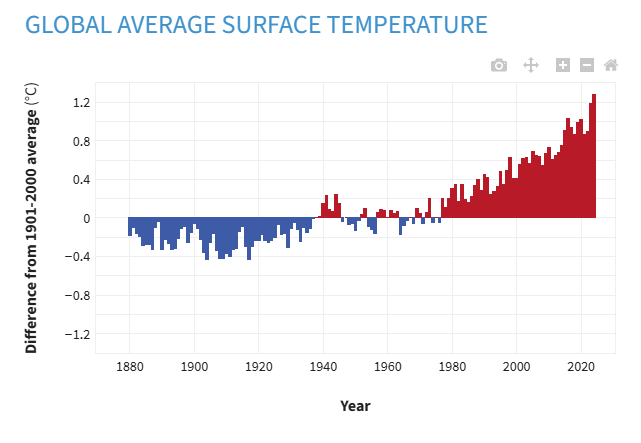
·        Between 1880 and 1980, the world surface temperatures were generally flat or below the historical medium of record keeping (1880-2025). After 1980, world surface temperatures have risen exponentially each year:

·        The world population in 1880 was 1.5 billion. By 1980 it was 4.4 billion. Today it is 8.3 billion. More people demand electricity, water, food, and a better life…and everyone generates methane producing garbage and waste.

·        Last year, renewables (solar and wind) surpassed coal as a source of electrical generation.

All facts. All alarming. Is this sustainable? How do we address the challenges? Serious problems cannot be solved by conspiracy theories, wishful thinking, complacency, and hiding them. Our only hope as a species is education, personal choices, and science to tackle and solve the problems.

So, back to my mother and the ruler. Don’t hide inconvenient facts and science. No omissions. The punishment (results) will be far worse than admitting them and dealing with them as best we can.

A RETROSPECTIVE VIEW WILL LEAVE AMERICA IN THE DUST

January 11, 2026 Kevin Patrick

Two hundred and fifty years ago this month, Thomas Paine’s pamphlet entitled Common Sense brought to the common man an understanding that past restrictions on freedoms and economic advancement did not have to continue. In plain language, it challenged the wisdom and stagnation of monarchy and hereditary class. It was perhaps the turning point that gave rise to our country. Today, we are at another fork where the wrong turn can lead to stagnation and the right turn can unleash limitless opportunity.

This past week highlighted these choices. The strength of America has always been its ingenuity and scientific advancements. So how do we feel when China is leaving America in the dust in renewable energy production? In a mere five months (from January to May, 2025), China added over 200 gigawatts of new solar power and 46 gigawatts of wind power (The administration’s claim this week that China has no windmills was wildly untrue). That five month increase is the amount of electrical demand that the country of Poland uses…not an insignificant amount. China is pulling away in renewable technology. Why? Direction. China’s autocratic government has seen the strategic risks of reliance on fossil fuels (sources from Iran, Venezuela, etc. are uncertain). China now has made the decision to endorse a future of clean, cheaper energy. Europe has too.

At the same time, in 2025 we saw the United States government proclaim a different direction: Retreat from renewables, cut research and funding, and pressure industry to return to a strict diet of fossil fuels. Whether industry bites has yet to be seen. Last week it was announced that the US would exit 66 international organizations, chief among them the Atlantic Cooperative and International Institute for Democracy and Electoral Assistance. These withdrawals are in addition to the suspensions of participation in the World Health Organization, UN Human Rights Council, and UN Framework Convention on Climate Change (a 1992 Agreement signed by 198 countries).

History is to be learned from, not retreated to. A yearning for the return of times past is nostalgia that endangers productivity, growth, and advancement. It is a path that leads to the rear.

It is also a strategy bundled with risk. An example: Between 2024 and 2025, the world’s oceans absorbed 33% more heat than in the year before (from 16 zettajoules to 23). One zettajoule is sextillion joules, or two-hundred times the electrical demand of every human on the planet (heat = energy). A warming ocean translates to risks loss of fishstocks (over a third of the Earth’s population’s food security relies on fishstocks) and more dynamic and violent weather patterns.  These are economic risks for everyone, whether you live on coasts or America’s Midwest.

With electrical demand expected to double in the next few decades and electric bills in the US rising, on average, at 13.9% yearly, renewables have overtaken coal for electric generation and are a path toward reduced grid reliance, lower utility bills, and less emissions.

Thomas Paine’s simple, plain language pronouncements for the colonies to progress toward a new moral, economic and political future and reject the constraints of the old structure have a certain ring today. Endorsing, instead of rejecting, new renewable energy technology is just Common Sense.

AN EASY NEW YEAR RESOLUTION: GIVING UP CRYPTOCURRENCIES FOR YOUR HEALTH

January 4, 2026 Kevin Patrick

We all make (and break) New Year resolutions. Unless you have incredible inner strength, you are like most of us. We break the difficult ones (diet, exercise, alcohol) and keep the few that are the easiest.

 “Health” is defined by the World Heath Organization as “a state of complete physical, mental, and social well-being and not merely the absence of disease or infirmity.” It is your broader existence. We all feel better when we do better things, are more financially secure, and have better surroundings. So, when I say health, I speak of your planet and your pocketbook, not just your absence of disease. What can you do to accomplish such lofty goals? Simple, avoid useless and negative things, people, and habits.

 But what does this have to do with cryptocurrencies? Crypto currencies are fraught by volatility, regulatory uncertainties, and scams. Few get rich. The few that create and sell them, not the vast majority of those that buy and own them. But has anyone ever discussed how damaging they are to the environment and your pocketbook?

 Crypto mining uses vast amounts of water and energy. A single Bitcoin transaction consumes the electricity that a single-family home uses in 15 days. That translates to around 500 kilowatt hours. Never mind the water necessary to cool the vast computer banks required for crypto mining, the generation of 500 kilowatt hours of electricity requires 1,000 gallons of freshwater. One transaction.

 Crypto mining in 2024 was estimated to require nearly 200 Terawatts of electricity. That’s 1,000,000,000 kilowatt hours. 71% of all crypto mining is concentrated in three countries: The United States (38%), China (21%) and Kazakhstan (12%). In the US, 66% of all electricity is generated by fossil fuels, in China its 77%, and in Kazakhstan, it’s 100%. That’s a lot of unnecessary emissions.

 But besides the fact that crypto mining consumes vast amounts of energy and freshwater water, new demands on an aging electric grid means significant required upgrades to utilities from generating to transmission. Since electric generation is largely conducted by public utilities, in all but a few instances, those new costs are spread amongst existing users, not allocated to the new industries that necessitate the upgraded infrastructure.

The crypto miners and data center developers are subsidized by you. That’s where your pocketbook health comes into the equation.

 These are the crypto industry titans that are pushing a crypto-friendly deregulatory mantra in Washington. The 2024 election saw cryptocurrency donors becoming the largest corporate donor (an estimated 238 million), surpassing oil, gas, and pharmaceutical lobbies. When that happens, it usually isn’t going to bode well for the common man who struggles to pay the utilities.

 Now then, when you think of easy New Year’s resolution to keep, you might include swearing off the crypto train. That’s my New Year’s resolution (and rant), since my other resolutions of more exercise, less alcohol, and a better diet look really hard and it’s only January 4th.


A POSITIVE NEW YEAR: 10 SUCCESSES ON THE ENVIRONMENT

December 28, 2025 Kevin Patrick

Here’s an understatement: It’s been a strange year. While over 70% of Americans support efforts to protect the environment, a sizeable chunk of the population believes 2025 was a setback to address climate change and negative impacts to our planet. Nothing could be further from the truth.

While the media focuses on the Trump administration withdrawing from the Paris Accords, cutting funds from climate research, slashing billions from renewables, and steps to recreate the 1950’s like promoting coal and other fossil fuels over renewables, the attempt has largely been just noise, ignored by industry and states.

It has been a year of advancement and major milestones for the environment. Here are ten successes to feel positive about:

1.    The Partisan Grip is Slipping. Sure, there’s a partisan divide with 80% of Democrats stating the environment as a top concern, contrasted with only 39% of Republicans, but the good news is that a majority of American voters don’t identify as either party. Latest statistics show that between 40 and 44 percent of voters identify as independents, not blindly following either party. (There’s a unique concept: Think for yourself. Form your own opinion.) With the partisan divide a stalemate, Republicans and Democrats are both minorities. Therein lies the 70% statistic.


2.    Renewables Surpass Coal. 2025 saw renewable energy sources (wind, solar, hydro) surpass coal in the global generation of electricity.


3.    England Quits Coal. The country that started the industrial revolution with coal, closed its last coal fired electrical generation plant in 2025. Wind (predominantly offshore) surged in Great Britain in the past three years.


4.    China Achieves Flat Emissions. Carbon emissions in China have been slashed by massive growth in solar and wind projects and slowdowns in heavy industry. Whether the trend continues is uncertain but for now, it’s good news from the world’s largest emitter.


5.    Ratification of the High Seas Treaty. In September, Morrocco became the 60th nation to ratify the Biodiversity Beyond National Jurisdiction (BBNJ) Agreement. It will now go into effect next month, promoting large scale protection of the world’s oceans from over-fishing, pollution, and loss of biodiversity critical to sustaining viable ocean fisheries. Currently only about 1% of these ocean areas are protected. The Agreement sets a goal of 30-35%. While the US signed the agreement in 2023, the Senate has yet to ratify it. But with the 60th nation’s ratification, it will go into effect with or without US ratification.


6.    Battery Storage. Battery storage is the game changer for renewables. When the sun isn’t shining or the wind isn’t blowing, renewables needed to be bundled with “instant on” generation such as hydro or natural gas. In 2015, less than one gigawatt of storage existed in the US. In 2025, storage exceeded 40 gigawatts, ten years ahead of the goal. With tariffs increasing turbine costs by as much as 100%, US made battery production and falling renewable energy costs have set the stage for massive gains. For perspective, just one gigawatt of storage can power 876,000 households for an entire year.


7.    States Take the Lead. With the federal government on the sidelines, states have stepped up. States have led the way to encourage renewables, resulting in lower electrical bills, and more resilient grids. And, these accomplishments have not just been in traditionally blue states. Even crimson-red states like Nebraska, Ohio, Oklahoma, Kansas, South Dakota, even Texas have seen huge growth in solar and wind and rejected efforts to marginalize renewable energy projects.


8.    Lower Costs for Renewables. Solar and wind generation costs continue to decline even in the face of tariffs. And with the expected doubling of electrical rates in the next decade due to the rise of data centers and AI, the incentive to generate one’s own electricity and reduce reliance on an over-stretched grid, will make the costs even more attractive for homeowners, industry, and government.


9.    Scientific Solutions to Plastic Pollution. Advancements in detection, collection and composting plastic were front and center in 2025. Magnetic microplastic capture (coils and additives that separate and capture microplastics from water), enzymatic recycling (enzymes that break down common plastics), and advancements in bioplastics (packaging that breaks down quickly), saw tremendous gains in new technologies in 2025.


10.  Information and education. In the face of science denial, the nation saw a rise in education and information available to everyone. The digital age has brought a wholesale leap in resources at the tips of the world’s fingertips that boost awareness, scientific understanding, and counter misinformation about our planet nurturing pro-climate/pro-environment sentiment.

While, as a thriller author, I tend to the threats side of a story, I felt compelled to offer a positive end to 2025 and wish everyone a happy, healthy, successful, and positive 2026!


A MERRY, BUT NOT SO WHITE, CHRISTMAS

December 21, 2025 Kevin Patrick

Economics and Priorities Aren’t in Santa’s Bag

The latest figures are out on (water) year to date precipitation and water content across the West. I might sound a little like Ebenezer Scrooge, but it’s looking a bit ugly. The latest figures are:

·         Colorado River watershed in Colorado is averaging 54% of normal

·         Colorado’s Gunnison River is at 57% of normal

·         Places like Independence Pass (above Aspen) and Vail Mountain are 39-40% (excluding snowmaking)

·         The Upper Rio Grande is at 59%

·         Arizona is a mixed bag between 5% and 21% with a few exceptions (Little Colorado River)

·         Utah is between 52-65%

·         New Mexico is between 25%-49%

So far, it’s the third driest year in Colorado out of the last 40 years (2000 and 2018 were slightly worse). It’s not panic time yet, most water content storms arrive in February-March in the Rockies, but it’s a looming concern. Forty million people rely on the Colorado River. Another fifteen million rely on the Arkansas and Rio Grande, all of which are fed by the Rockies that are in sustained drought.

Water planners and agriculture keep a close eye on these figures. Fifty-five million irrigated acres provides the backbone of what is placed on America’s dinner tables. Data, records, modelling, and science in the field of water planning and agriculture is the difference in America between food security and insecurity.

Who provides this data? The National Oceanic and Atmospheric Administration (NOAA), the National Water and Climate Center of the US Department of Agriculture, National Weather Service, and the National Center for Atmospheric Research. Not having this critical information could cost lives and billions in economic harm to farmers and American industry.  So, when NOAA’s budget is cut by nearly 30%, the USDA’s budget is cut by $7 billion, the National Weather Service staff is cut by an estimated 30%, and it is announced that the National Center for Atmospheric Research is scheduled for elimination, one asks whether the people making these decisions understand what these agencies do.

Put simply, they are the difference between the  21st century and the 19th century. Storm forecasting, SNOTEL monitoring, public safety, groundwater modelling, flood monitoring and prediction…I could go on.  It’s pulling the rug out from under science and how lives, industry, investment, and food security have become second thoughts to tax cuts for a select few of the wealthy. This shouldn’t be political: Every American in every state has an interest in low grocery prices, water and food security, and lower utility bills. So, ask yourself why industries like cryptocurrencies (which produce no public good, while using vast amounts of water and energy), are subsidized and fostered while science (and stable economics) is shelved.

For Christmas, I’m asking Santa to bring back Congress, science, and common sense.

YOU DON’T HAVE TO BE A WEATHERMAN TO KNOW WHICH WAY THE WIND BLOWS

December 14, 2025 Kevin Patrick


Bob Dylan’s 1965 song Subterranean Homesick Blues used this line as did the radical SDS (Students for a Democratic Society) splinter group Weathermen in the 1960’s. Various permutations of the phrase can be traced to “The Packet” published in a 1799 issue of the Porcupine Gazette. The meaning of the phrase can be shortened to one three letter word: Duh. In other words, a truth so obvious, one need not look any further upon.

We are confronted with many Duh moments. Do we ignore them? Disparage them, or lean into them? I’ll throw a few out:

1.      The Earth is not flat;

2.      American politics are polarized;

3.      There is good and evil in the world;

4.      The sun rises in the East and sets in the West;

5.      Water is a liquid, water vapor is a gas, ice is a solid;

6.      Climate change is real.

How many will challenge the first five as “Duh?” Anyone challenging the first one we can leave out of the discussion as there are deeper issues there. What about that number six? There are still many among us that will not admit climate change is real. Climate denialism is a form of science denialism as the consensus of the scientific community finds that a Duh moment. It’s not that those who question climate change are lacking in intellectual capacity (they aren’t, they just have a different belief system), it is the sources that frames one’s beliefs have become chambers.

We all use our phones and computers to seek answers to questions and to broaden our understanding. These tools all use algorithms that manipulate what we see. How many times have you clicked on an ad or article only to see a deluge of similar items or articles delivered to your feed? Organizations like the Heritage Foundation, the Heartland Institute, and Fox News manipulate the right. On the left, the Center for American Progress and MSNBC steer the left.

These algorithms and influences harm. It’s the profiteering of division. They have no place in honest discussions of science or matters of water, food security, and critical infrastructure. They rhetorically manipulate our fellow citizens for the sponsor’s ulterior goals. Short of disconnecting, it’s hard to escape these manipulations. What we can do is challenge ourselves to seek viewpoints outside of our own echo-chambers. And, when confronted by self-proclaimed “skeptics” on an issue of science, know that the term skeptic is being misused. Skepticism is a part of the scientific method. Denialism is the opposite of the scientific method. It is a conclusion searching for a basis.

The next time you are confronted by a “skeptic,” research that source. Is the source funded opposition research? What entities are the sponsors of the skeptic? Of course, the downside is that after you do that online research, you’ll have a whole new set of algorithms that will chase you. It may make you go back to the Dewey Decimal System (for those born after 1995, you may have to look that up).

P.S., the photo confirms the Earth is flat, really, I read it online. 

COHERENT WATER POLICY ISN’T SEXY

December 7, 2025 Kevin Patrick

The photo made you look, right? Since when does the social media universe dictate what issues are addressed? Let’s face it, water policy isn’t sexy. In the present environment, Kim Kardashian and Pete Hegseth’s tattoos garner greater attention than real water issues that threaten the economy and American lives. I’m talking about water scarcity, water infrastructure resilience, pollution (PFAS, industrial waste, arsenic in groundwater)… those kinds of issues that seldom make it to the forefront.

The United States faces very real and very serious challenges in the water sphere, all of which can be tacked and solved. Instead, a sizeable share of the population, Congress, and the executive are content to do nothing, claim the problems are fake, or push the problems off to the next administration and the next Congress.  While President Trum is doing his best to ignore science, climate impacts to water sources, and politized water, the blame hardly started with the Don. Administration after administration both on the federal level and in some states are also to blame, left and right.

Take for instance forever chemicals in water (PFAS), that have been proven to an increase in certain cancers, decreased immunity function, and adverse children neural development. It took too long for regulations to be established and once they were, they were swept aside. Not a problem. Studies and data relied upon by water planners and water engineers have disappeared from view. Problem solved. Politics have never been divorced from water, but recently science is being estranged.

States and municipalities that have some of the most serious water scarcity issues covet data centers. Never mind that a data center can consume the same amount of water as a small city. Never mind that these same data centers require wholesale upgrades to the power grid and look to the local populous to subsidize those costs.

So, what can we do to put some lipstick on the water issues so they receive real attention? Here’s  small, and by no means exhaustive, list:

1.      Regulate the siting of data centers. They belong in water secure locales.

2.      Encourage state public utility commissions to make those new industries that dramatically increase electrical costs (new infrastructure, new power plants) to pay their share. Make growth pay its own way.

3.      Discourage cryptocurrencies. They serve no positive societal function and yet consume vast quantities of water and electricity.

4.      Increase revolving fund programs to harden resilience of municipal and agricultural water supplies to meet the challenges that population increases have on demands and climate changes have on decreasing supplies. It isn’t a left or right thing, it’s an economic thing: supply and demand.

5.      Stop playing political games. Sound bites that claim “the radical left” Californians are to blame for empty fire hydrants was not only false but ignored the real issues. The act of turning water south into the Central Valley Project hurt supplies, it didn’t deliver one drop to southern California municipalities.

6.      Crop subsidies have been around for nearly a hundred years. Incentivize drought resistant crops and farming practices. There is no reason to grow rice, cotton and almonds in the great American desert.

7.       Begin to think of water a little more like other natural resources. Think of water regionally, not locally. I’m not talking about a greater role for the federal government (which doesn’t belong in most water quantity issues), but more regional cooperation.

8.      Accept the science. Perhaps no other resource is impacted greater by climate change than water. In the real world of water supply planning and management, there is no left and right, there is only supply and demand and a recognition of the science and economics that impact supplies.

I could go on but I may have ranted enough. I’m going back to writing thrillers that aren’t as scary as these threats.


← Newer Posts Older Posts →

COMING SOON

© 2024 Kevin Land Patrick