

“Assumptions are made and most assumptions are wrong”. Albert Einstein
The study of water resources merges three sciences: Weather, Climate, and Hydrology. The first two, weather and climate are vastly different concepts that many misconstrue as the same thing. Weather is a short-term snapshot of the local atmosphere, which can vary greatly from hour to hour, day to day. Climate is a predictable average of the long term weather conditions usually collected and averaged over decades of actual observance.
When people make comments like “there is no climate change or global warming, just look at the record winter we had last year” they make the mistake of thinking weather and climate are synonyms…which brings me to another Albert Einstein quote: “Only two things are infinite, the universe and human stupidity, and I’m not sure about the former”.
This past winter saw a rather chaotic weather pattern. The Northeast was hammered by brutal back to back winter storms, while the Rockies and the Southwest had little to no snow and warm temperatures that had never been seen (in March, high elevations in the Rockies saw a week of 80 degree days while Phoenix experienced multiple hundred degree days). These events are weather, not climate.
What both have in common is energy.
A warming climate means a warmer atmosphere. As the atmosphere warms, the level of energy in the atmosphere elevates. Evaporation from moisture and water on the Earth’s surface increases. And this transfer of moisture from the earth to the atmosphere isn’t limited to warm seasons. The colder it is, water vapor is sublimated into the atmosphere from snow. Uneven warming creates temperature and pressure variations, which in turn, moves air from high to low pressure; the result is wind.
What goes up must come down. That atmospheric moisture rises, cools and comes down as rain or snow. The more moisture, the more storms. The more heat, the more energy, the greater storm events.
Water resource planning for ranchers, municipalities, recreation, and industry is predicated on climate assumptions. We know there are wet and dry years, warm and cold years, it’s natural. These are known assumptions and water planners take into account how often (on average) each occur and how extreme they have been in the past. These assumptions then serve as a template from which future water supplies are predicated.
Enter the era of climate change. This period commenced with the industrial revolution but really came to a head as the earth’s population swelled resulting in acceleration of the effects of greenhouse gases. Population is the multiplier as every new soul wants electricity, food, transportation…things. The chart below tells the story:
US POPULATION WORLD POPULATION
1850 23 million 1.26 billion
1900 75 million 1.66 billion
1990 249 million 5.30 billion
2026 345 million 8.30 billion
Match the population trend against the global temperature rise:
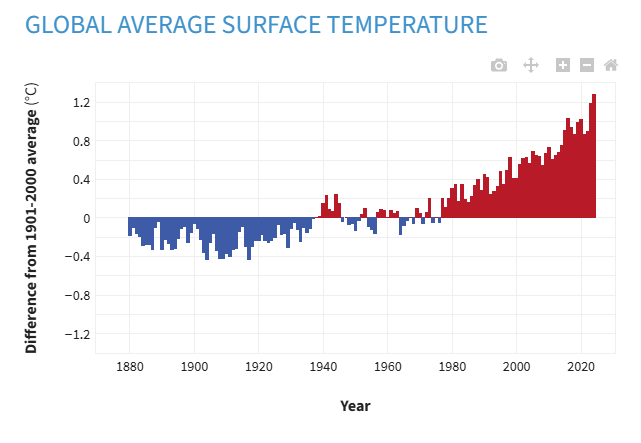
It’s hard (impossible) to empirically assert that anthropogenic (human caused) climate change isn’t fact.
In the western United States, record keeping of weather events and water levels first began in the late 1880s. Things were fairly static until 1990. Droughts were measured once in every ten or twenty years. In America, since 2000 the West has seen 19 years of drought out of the last 25 years. Most of those years broke all records. Tree ring analysis shows the last 25 years have been the driest in the last 1200 years. When you look at the last three decades, those trends and averages constitute climate.
So now we have seen over three decades of empirical evidence as to climate. It should then come as no surprise that hydrologic assumptions generated before the last thirty years are wrong. Dead wrong. Yet, those are the assumptions that have underpinned water law, the relationship of the states on the Colorado River (Law of the River), and water planning. Bad assumptions lead to bad results.
In 2011, I presented a paper at the XIV World Water Congress in Brazil entitled “Compelling Adaptive Water Management to Meet the Challenges of Climate Change”. I think about ten people read it. It identified the need to not rely on historical assumptions in planning for the future. For engineers, such talk is blasphemy.
We will have to adapt to a changing climate if we are to address the challenges of a changing world. Finance, medicine, technology, most disciplines do. For some reason, lawyers and engineers have problems escaping the past. Sometimes it takes a near biblical drought to jar ideas.